This is a coup in progress.
Not the kind with tanks. Not the kind you saw in Venezuela in 2002 or Turkey in 2016 or Honduras in 2009. The 21st-century kind. The kind the American government spent four decades financing overseas. The kind that runs on civil society and encrypted communications and coordinated insider noncooperation. The kind the academic literature studies as electoral revolution, that the governments on the receiving end call regime change, and that the people who designed the methodology have always been honest about the goal of.
The goal is removal of the sitting government.
It is happening here, in the United States, right now. It is being run substantially by former United States federal employees — specifically by the diaspora of the U.S. Agency for International Development after its January 2025 closure. It is being financed by foundations whose funding streams overlap with ones currently under Senate investigation. It is coordinated with more than thirty sitting members of Congress through a formally announced caucus. And on April 15, 2026, on an encrypted Jitsi call attended by thirty-nine people including federal worker leaders from eighteen agencies, its operational leader endorsed on the recording the statement that the objective is to "shut down the country until Trump is removed from power."
The recording exists. It is in OUR possession. What follows is the first installment in an eight-part series establishing what the primary-source record shows.
A People's Brief Report discussing the contents of this investigative piece and offering commentary on this series.
Watch on YouTube: youtu.be/EXg_nPZatfo
The Room at Foggy Bottom
On September 15, 2021 — International Day of Democracy — Kourtney Ann Pompi walked into a room at the United States Department of State.
She was there by invitation. She was a named member of the Core Group coordinating President Biden's first Summit for Democracy. She worked out of the Bureau of Democracy, Human Rights, and Labor. She sat alongside Deputy Assistant Secretary Kara McDonald, Coordinator for Global Democratic Renewal Erin Barclay (from Under Secretary Uzra Zeya's office), and a small cluster of career-track colleagues.
Their job was specific: coordinate American civil-society engagement with democracy movements overseas. In places Washington considered undemocratic. Where civil resistance, properly supported, could force a government out.
That is what Kourtney Pompi had done, for a living, for more than twenty-five years.
The Career
Pompi began her career in 1999 as an election observer for the Organization for Security and Co-operation in Europe. OSCE election observation is the Euro-Atlantic gold standard — the credential that opens every door in the democracy-promotion sector. She held it for fifteen straight years, through October 2014.
She then rotated through the full roster of major American democracy-assistance implementing partners: the International Republican Institute, the National Democratic Institute, IREX, Counterpart International (where she rose to Senior Director of the Governance Practice Area), Democracy International, Creative Associates International, Camris International, Social Impact, International Alert, and the International Organization for Migration. Every one of these organizations is funded substantially or exclusively by USAID or the Department of State.
From February 2017 to February 2018, she worked directly at State — as a program analyst in the Bureau of Democracy, Human Rights, and Labor, contracted through Kenjya-Trusant Group. That is the federal-contract service she would later reference on a recorded call.
In 2023, now Director of Civic Engagement at Counterpart International, she appeared at Partners for Democracy Day, a civil-society event run alongside the Summit for Democracy. Speaking on the same program that day was Rosarie "Ro" Tucci, then Director of USAID's Center for Democracy, Human Rights and Governance. Remember that name.
In March 2024, Pompi was in Seoul at the Third Summit for Democracy, speaking on a panel about creating a United Nations Special Rapporteur on Democracy. She told the audience: "the necessity for this mandate has never been greater."
In December 2025, she was bio'd in the Global Democracy Coalition's "When Aid Fades" program as the founder of KP Global Consulting, with "over 25 years of international development experience in more than 50 countries."
Every rung. Every year. Either inside the United States government or inside an organization substantially paid for by the United States government.
She was, in the most literal possible sense, an instrument of American foreign policy.
The Instrument Repointed
On Wednesday, April 15, 2026, at approximately 8:00 PM Eastern, Kourtney Pompi opened her laptop.
The meeting platform was Jitsi — encrypted, open-source, deliberately selected in preference to Zoom.
The host organization was the Federal Workers Alliance for Democracy (FWAD). Thirty-nine participants joined. Among them: senior FWAD leadership, twenty-six federal worker leaders representing eighteen federal agencies (a mix of currently employed and recently separated), and representatives of eleven partner organizations.
The call was recorded.
Pompi was the first substantive presenter. She was introduced by a FWAD leader as "a key part of our training team that has helped us with non-cooperation training."
She did not come to teach civics. She came to teach three foreign case studies.
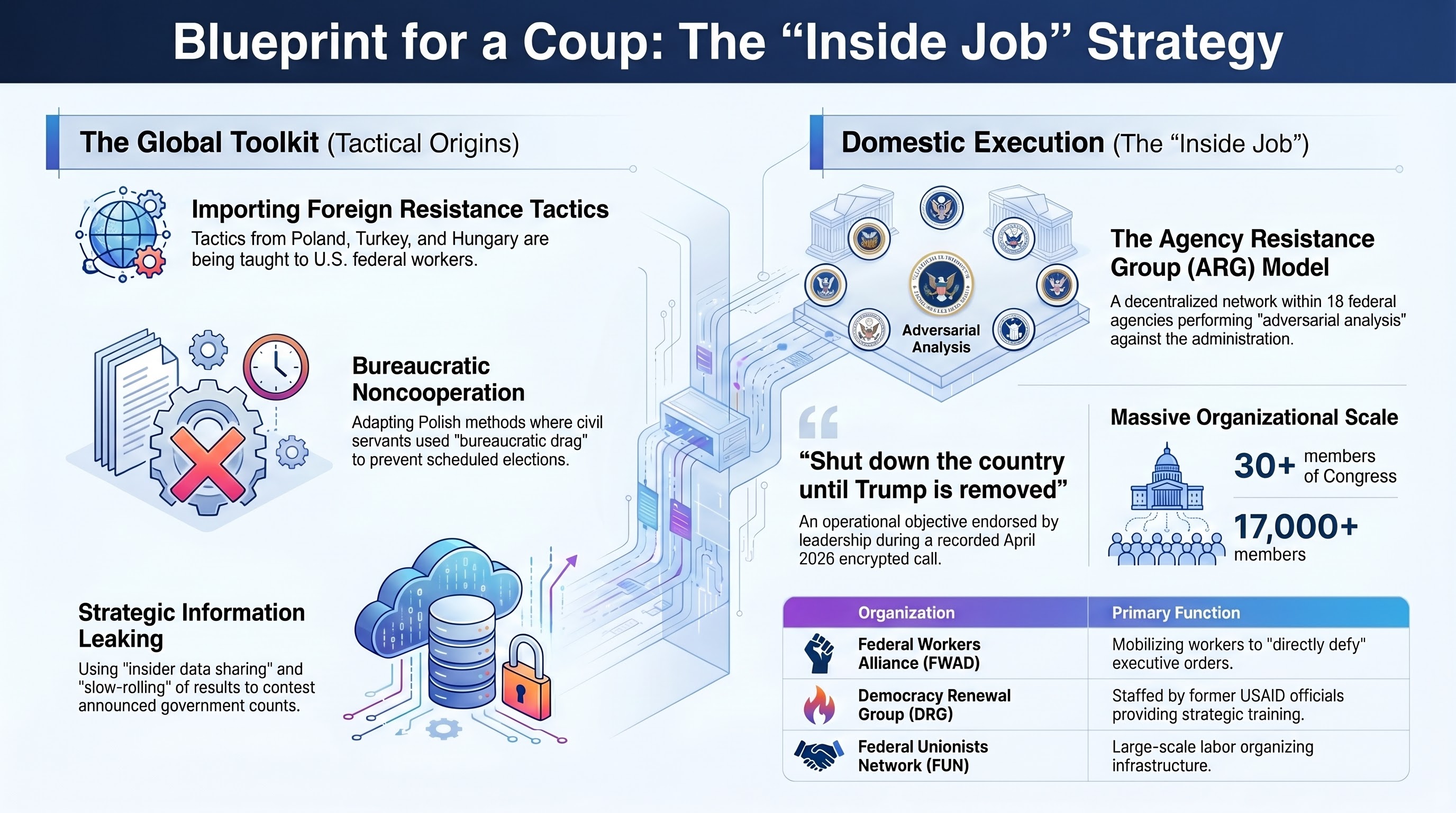
The Case Studies
Poland
Pompi walked the call through how, between 2017 and 2020, career civil servants inside Poland's national election office refused to hand over voter-registration data to Poland's Law and Justice government. She described how they "publicly warned folks that these changes would create very much a chaotic election environment." She described how judges used their platforms to issue legal opinions against the reforms. She described how the bureaucratic drag imposed by career administrators made it "logistically impossible to hold the election on a scheduled date." She described how the domestic dispute was internationalized by referring it to the European Court of Justice.
This is a textbook description of career-civil-servant noncooperation with an elected government. Pompi framed it not as dysfunction but as successful resistance.
Turkey
Pompi told the call that after the 2016 Turkish purges, resistance to the ruling party "often happened via insider data sharing or through massive volunteer coordination that bypasses traditional bureaucracy, so using insider information, using those connections kind of inside the building versus outside."
She described Turkey's Oy ve Ötesi civil-society initiative — a parallel shadow vote count run by hundreds of thousands of volunteers using a mobile app.
Then, verbatim from the transcript:
This bureaucratic whistle blowing effectively allowed sympathetic local election clerks who were unable to speak out publicly to provide information to party observers. Then they were able to use that information to slow roll the data.
Read that sentence twice. A former State Department contractor and 15-year OSCE observer was teaching thirty-nine Americans — including currently employed federal workers — how Turkish election clerks leaked live election results data to opposition observers to undermine their own government's announced count.
She taught that tactic on a recorded call. Inside the United States. Aimed at U.S. federal workers.
Hungary
Pompi walked the call through how "low-level leaks" of personal data from Hungarian public-service databases had been fed to journalists to expose how Prime Minister Viktor Orbán's Fidesz party used state information for political purposes.
She walked them through the "Peter Magyar phenomenon" — the 2024 defection of a former Fidesz insider who took his inside knowledge directly to voters and built the Tisza Party into the principal challenger to Orbán's rule.
These are not abstract civics lessons. These are specific opposition tactics, deployed in three specific anti-conservative-government campaigns, producing three specific results in European politics between 2020 and 2024. They come directly from the training library of the Horizons Project — run by Dr. Maria J. Stephan, former State Department Bureau of Conflict and Stabilization Operations official and co-author of the civil-resistance scholarship that underwrites modern pro-democracy training in the United States.
They trace back, at root, to Gene Sharp's Albert Einstein Institution in Boston, whose instructional manual was titled From Dictatorship to Democracy. And to Srdja Popović of Serbia's Otpor movement, whose memoir of exporting the Otpor model to two dozen countries was titled Blueprint for Revolution.
The architects of the methodology have always been honest about what it is for. Sharp, Popović, Chenoweth, Stephan, and the institutions that built around their work — from the Albert Einstein Institution to ICNC to Horizons — treat the objective as a matter of operational design, not rhetoric: strategically applied civil resistance ends with the sitting government gone.
That is the methodology Kourtney Pompi taught, on April 15, 2026, to thirty-nine Americans, aimed at the sitting administration of the United States government.
What the Coalition Says It Is Doing
Before walking further into the recorded call, it is worth stating plainly how the organizations in this coalition describe their own work — in their own published words, on their own public websites.
The Federal Workers Alliance for Democracy describes itself on its homepage as "a coalition of federal workers and allies, mobilizing the federal workforce to directly defy dangerous, illegal orders." It frames its purpose as a response to what it characterizes as "an all-out attack on this nation's vital services: Social Security, Medicare, cancer treatment, clean water, travel safety, fire prevention, global aid, fraud prevention, veteran care, and democracy itself."
Branch4 describes its mission as working "with civil servants, grassroots movements, community organizations, and advocates toward a democratic and equitable administrative branch of government that delivers just results for all." It frames Project 2025 as "a radical acceleration that poses a direct threat to safety, stability, and freedoms across the United States."
The Federal Unionists Network describes itself as "a worker-led effort to defend democracy and transform the federal government from within," rooted in labor organizing principles and solidarity.
The Democracy Renewal Group, per its Harvard Kennedy School Ash Center launch description in January 2026, describes itself as "a non-partisan organization" whose members are "educating citizens on the risks to our democracy and what they can do to reclaim their voice and place in our democratic society."
These are the stated justifications. They should be taken seriously as statements of intent — and then compared to the language in the primary-source record.
The words on the public websites are defending democracy, illegal orders, equitable government, non-partisan, educating citizens.
The words on the recorded April 15 call are adversarial analysis, know the enemy, points of leverage, Agency Resistance Groups, until Trump is removed from power, amen. The tactics being taught are those of Turkish election clerks slow-rolling data, Hungarian civil servants leaking personal data from public-service databases, and Polish bureaucrats internationalizing a domestic election dispute.
Both sets of words come from the same organizations, in the same weeks, from the same leadership. Readers are entitled to weigh them together. This series will continue to set them side by side — the public framing and the primary-source record — and let the difference speak.
Acknowledging what the coalition says it is doing is not the same as accepting it. It is how serious journalism engages the public record of the institutions it reports on.
The Recorded Call
After Pompi finished, the FWAD operational leader presented the organization's revised strategy.
FWAD would now be structured around Agency Resistance Groups — "ARGs" — described as "the centerpiece of our entire strategy."
The org chart included a Shared Services Layer with functions labeled "Risk Mitigation and Harm Reduction" and "Information Gathering and Analysis." On that latter function, the transcript is explicit:
adversarial analysis — this is kind of a know the enemy, understand what the administration is planning to do, and identifying points of leverage for people to engage in resistance.
The enemy, in that sentence, is the sitting executive branch of the United States. The people identifying its points of leverage are current and former federal employees.
The call also described a bidirectional coordination model with elected officials:
We have federal workers supporting elected leaders, members of Congress. This is us empowering electeds to do better oversight policy and appropriations. And then we have elected supporting federal workers. This is elected to powering us as federal workers to more effectively constrain executive overreach and act as direct checks and balances on authoritarian consolidation and lawlessness.
FWAD and its partner organizations publicly describe this kind of arrangement as "empowering checks and balances" and "supporting civil servants who are upholding their oath." The transcript describes the sitting executive branch as "the enemy" and its own members as "constraining" that branch through coordinated noncooperation. Both descriptions originate with the same leadership, in the same period, about the same activity. Readers can decide which characterization the evidence supports.
That said, the legal test is not a semantic one. Oversight happens in hearings, in public, under subpoena. What is described in that passage is operational coordination between an outside political coalition and sitting members of Congress, through a coalition whose strategic document names the removal of the sitting president as its objective.
The scale matters. The April 15 call had thirty-nine participants. Those participants included twenty-six federal worker leaders representing eighteen federal agencies, along with eleven partner organizations. One partner organization alone — the Federal Unionists Network — reports 17,000 federal-worker members. The Congressional Federal Workforce Caucus, which Part Four of this series will document in full, has more than thirty members of Congress. This is not a small operation. It is a coalition that draws from thousands of current and recently separated federal workers and coordinates with dozens of lawmakers across both chambers. Whatever descriptive terms are ultimately used for it, "fringe" is not among them.
The Federal Unionists Network (FUN) — the 17,000-member federal-worker organization and the largest single component of Branch4's organizing infrastructure — was confirmed on the call as a participant in the weekend strategy convening that produced the FWAD 2.0 framework. Part Two will name its leadership in full.
The Line That Was Said Out Loud
Forty minutes in, one of the participants on the call spoke.
He referenced the April 7, 2026 Iran strike, and the eight-million-person "No Kings" street mobilization that had preceded it ten days earlier. Then, verbatim from the transcript:
If something like that happens again, or the day after the election, when they seize the ballots and declare like none of that counted, we're going to need the ability to rally people on short notice to not have a parade, not have a festival and a demonstration, not a demonstration of our numbers, but maybe a demonstration of our power and actually withdraw cooperation and shut down the country until not just the election results are respected, but until Trump is removed from power.
The FWAD operational leader replied, on the recording, with thirty-nine people listening:
There's so much that I could say in response to that, but I think the shortest thing that I'll say is amen.
That is the record.
Three Things the Record Shows
The methodology is a coup methodology.
The tactics Pompi taught on April 15 are studied in the academic literature — by Lincoln Mitchell at Columbia, Michael McFaul at Stanford, Mark Beissinger at Princeton, and Thomas Carothers at Carnegie — as the mechanisms of electorally-triggered regime change. Every government on the receiving end of one of these operations, from Belgrade in 2000 to Kyiv in 2004 to Tehran in 2009 to Caracas in 2019, has called it a coup. The Chenoweth-Stephan research that underwrites the methodology was built to answer one question: how mass noncooperation brings a government down without firing a shot. The coalition teaching this methodology to American federal workers in April 2026 is working from the same body of scholarship, aimed at the same class of outcome.
A coup does not require tanks. It requires the unlawful or extra-constitutional displacement of the sitting government, typically through contested-election narratives, insider noncooperation, and mass mobilization. That is precisely what was described on the April 15 call.
The person teaching the methodology was a U.S. government instrument.
For twenty-five years. Fifty countries. The U.S. government paid for Pompi's career. When USAID was closed in January 2025, the personnel did not retire. They regrouped — first as DemocracyAID, then, rebranded with a public launch at Harvard's Kennedy School Ash Center on January 29, 2026 under the moderation of former USAID Administrator Samantha Power, as the Democracy Renewal Group.
DRG's named principals, as of April 2026, include Pompi and three other former USAID figures identifiable from public records: Rosarie Tucci (former Director of USAID's DRG Center), Danielle Reiff (14-year USAID diplomat), Bryce Carpenter, Ph.D. (former Chief of Staff to the USAID CIO who served as Acting Administrator on Inauguration Day 2025), Chris Doten (led USAID's Advancing Digital Democracy initiative), and Jennifer Pike (14-year USAID Foreign Service Officer across six embassies).
These are not outside critics of the current administration. These are personnel of the previous administration's foreign-policy apparatus, now pointed inward.
In July 2025, one of their collaborators — a currently employed federal official speaking to NOTUS on condition of anonymity — said this:
Take it from those of us who worked in authoritarian countries: We've become one.
And in the same interview:
You just released a bunch of well-trained individuals into your population. They were so quick to disband AID, the group that supposedly instigates color revolutions.
A currently-employed federal official. On the record. Identifying his own former agency's operational role by its correct technical name.
The characterization in this piece is not imposed from the outside. It is confirmed from inside.
The operational leader endorsed the objective, on the recording.
He did not qualify the "shut down the country until Trump is removed from power" statement. He did not redirect it. He did not walk it back. He said "amen."
The context in which he endorsed it is worth stating plainly. The statement was made in direct reference to a post-election scenario — specifically, the speaker's framing of what the coalition should do "the day after the election, when they seize the ballots and declare like none of that counted." The "amen" was an endorsement of mass noncooperation and country-wide shutdown as the coalition's planned response to a contested 2026 midterm result the coalition has pre-emptively characterized as fraudulent. This is not abstract discussion. It is forward-planning for a specific contingency, six to seven months before the election it contemplates.
The question is no longer whether a domestic political campaign exists. The record establishes that.
The question is whether the American enforcement apparatus — the Office of Special Counsel for the Hatch Act, the Department of Justice for 18 U.S.C. §§ 1918, 1503, 2384, and 2385, the Internal Revenue Service for tax-exempt status review, the Federal Election Commission for foreign-national electioneering prohibitions, the Presidential Personnel Office for personnel determinations, the Department of State for the USAID successor portfolio, and the Department of Defense for UCMJ Article 94 where retired-with-pay service members are involved — recognizes what the primary-source record establishes, and acts.
Several of these statutes — particularly 18 U.S.C. § 1918, 5 U.S.C. § 7311, and the Smith Act at § 2385 — have rarely been enforced aggressively against coordinated federal-workforce noncooperation in the modern era. They remain fully on the books. The reason they have not been exercised at scale is not that the underlying conduct has been absent, but that the documentary record of coordination has historically been hard to assemble. The April 15, 2026 recording, together with the public membership rosters, the fiscal-sponsor 990 filings, and the coalition's own published strategy documents, is that record.
What Comes Next
- Part Two will name the principals — the Democracy Renewal Group, the Branch4 executive team (Albisa, Dols, Tafti, Mediratta), FWAD leadership, the Horizons Project and 22nd Century Initiative, the Freedom Trainers, the International Center on Nonviolent Conflict, and the Better Choices for Democracy board.
- Part Three will walk the April 15 recording in full — what was said, by whom, in a meeting encrypted so the record was not supposed to exist.
- Part Four will name every member of the Congressional Federal Workforce Caucus and every member of Congress featured in the November 2025 "illegal orders" video — and document the bidirectional coordination their caucus was designed to provide.
- Part Five will put the operation at physical polling places in Pennsylvania, Ohio, and Georgia — where a 501(c)(4) incorporated in Austin, Texas, in 2024, with EIN 99-3918413, is pre-positioning observer operations recruited specifically from 2025-separated federal workers.
- Part Six will follow the money — the conduit fiscal sponsors, the foundation grants, the Swiss national who has given $245 million to domestic political infrastructure, the Ford Foundation disclosures Senator Grassley has demanded, and the Rockefeller Brothers Fund China exposure.
- Part Seven will lay out the statute book — UCMJ Article 94 (death penalty for sedition, currently being examined against Senator Mark Kelly), and the civilian equivalents at 18 U.S.C. §§ 1918, 2384, and 2385.
- Part Eight will be the prosecutorial road map — eight referral-ready files, eight enforcement authorities, the statute and the evidence for each.
A Final Word
The people Kourtney Pompi trained alongside, worked with, and spoke at conferences with between 2017 and 2024 are running a coordinated domestic political operation aimed at the administration you serve. Some are still drawing federal contracts. Some are on Foreign Service retirement rolls. Some are in your current chain of communication. It is worth knowing who, and it is worth understanding what they are doing this spring.
The Agency Resistance Group model described on the April 15 recording rests on currently employed federal workers, by the operational leader's own words, "constraining executive overreach." The civilian overthrow statutes — 18 U.S.C. § 1918, 5 U.S.C. § 7311, the Hatch Act framework — were written for exactly this pattern. They attach to membership. They attach to advocacy. They do not require proof of force.
The bidirectional coordination model described on the April 15 call is not oversight. You know this. Your legal counsel knows this. What the FWAD operational leader called "elected supporting federal workers … empowering us as federal workers to more effectively constrain executive overreach" is a description of activity with a different name in the statute book than the one in your press releases.
The record of what you have done is accumulating. In transcripts. In IRS 990 filings. In press releases your own organizations issued. In public bios your colleagues wrote. In panels you spoke at. In photographs from public events. The people documenting this include veterans who took the oath, current and former federal officials who took the oath, prosecutors who took the oath, and citizens who never took an oath but understand what one means.
This is a coup in progress.
Not metaphorically. Not rhetorically. Under the academic, operational, and historical definitions of a non-military regime-change operation.
The evidence is primary-source. The personnel are publicly identifiable. The funding is traceable. The coordination with elected officials is on record. The objective was stated out loud on a recorded call and endorsed by the coalition's operational leader.
This series is the opening of the public record. Seven more installments follow. Every name. Every dollar. Every statute. Every receipt.
If You Have Something to Contribute
If you are a current or former federal employee who attended the April 15, 2026 Jitsi call, or similar coalition calls, and you want to contribute documentation to this investigation: secure contact information is available at toresays.com. All communications will be protected.
If you are a congressional staffer with materials from the February 4, 2026 Federal Workforce Caucus launch briefing — or subsequent coordination meetings with Branch4, FWAD, FUN, or the Democracy Renewal Group — the public interest in what was promised and to whom outweighs any internal confidentiality expectation. Secure contact at toresays.com.
If you are a participant in the coalition who has reached the limit of your comfort with where the operation has traveled — you have options that do not end your career. Office of Special Counsel whistleblower protections exist. Inspector General channels exist. Legal counsel, with privilege, exists. The record has a place for your testimony.
"It's not the story they tell you that is important. It's what they omit."
— Tore